Showing posts with label ideas. Show all posts

Thursday, December 14, 2017

Out at Sea


Two summers ago I went to Mystic, Connecticut. We visited the Mystic Seaport which is a port with museums, fun activities, and whaling boats! As I come to the nautical part of my book I am brought back to Mystic Seaport for some nautical knowledge. I came across Captain George Comer, who was a foster kid! and Captain, (first set sail at age 17), and anthropologist (extensively studied the Inuit!) All three fit my book. 

http://www.mysticseaport.org/index.cfm?fuseaction=home.viewpage&page_id=0E0A66FA-65B8-D398-73AF33D5C768027A

Captain George Comer: By the Numbers

Some of the amazing statistics Comer accumulated during his 14 Arctic voyages:

  • Typical voyage length: 27 months
  • Total time away from home, 1875-1919: 23 years
  • Number of surviving journals and notebooks: 30
  • Number of photographs taken: 300
  • Number of sound recordings made: 65
  • Number of Inuit artifacts collected for museums: 4,000
  • Number of plaster life masks made: 300
  • Close calls: 2 shipwrecks, 2 near-drownings and 1 attempted shooting
Comer on a ladder

Details about the schooner Era's voyage to Hudson Bay, 1903-05:

  • Number of crew members: 20
  • In pounds, amount of bread brought along: 21,803
  • In pounds, amount of coffee brought along: 1,900Comer's men
  • In pounds, amount of sugar brought along: 1,982
  • In Fahrenheit, coldest temperature registered
    during their stay in Hudson Bay:
     -53 degrees
  • In feet, thickness of ice measured: 6' 3"

Another helpful site is this one I came across early one morning. The Bounty Blog that follow Tall Ship Bounty on an adventure sailing this summer along the East coast from Florida, above Nova Scotia.  


To help know the tides...

And, in case I want my characters to hitch a ride on some cargo
http://www.panynj.gov/port/ocean-shipping-schedules.cfm


A  live view of Nanasquan Inlet, NJ to get the feel of the ocean as I am writing

http://www.surfchex.com/manasquan-web-cam.php

Saturday, January 5, 2013

Where is the Black Hero in Literature for Teens?

Disclaimer:
I am not suggesting there are race problems in America. In fact, we need to realize there is less racism than we think. Focus on the good. An interesting book on American view on race is :  Negrophilia: From Slave Block to Pedestal—America's Racial Obsession

I love literature. I love heroes and heroines. I once had a foster child that was two years old from Liberia. He was with us for two years. The one thing I wished he had was a black hero to look up to. At the time children had Harry Potter, Alex Rider, and most Super Heroes are Caucasian i.e. Spider-man, Thor, The Hulk. We need a black hero!

Our little boy stayed with us for two years and forever changed our lives and the way we look at the lives of others. I stay in touch with him and talk to his mother over the phone on Tango. She shares stories from Africa and shares that she misses Africa. She has been in the United States since about the age of 10 and still misses Africa! This surprises me because everyone wants to come to the United States, right? The United States isn't everything if you don't have help and support or family. She misses her family most of all. She said in Africa they help each other- in American we are expected to do everything by ourselves. This is hard for a single mother!

I now have a African American girl I have adopted. Her roots are in Louisiana and Cuba. The history of Cuba and blacks is very interesting and another story. But, her roots are now with us. And I want her to love herself for her differences i.e. kinky hair, brown skin, wide nose, full lips and a beautiful round bottom!
I don't want her to desire straight hair, fair skin, or less of her body. She is beautiful and I want her to love herself. I love every thing about her curled eyelashes to her brown toes.

The one thing literature is missing is a good black hero and/or heroine. My story did not begin with, "hmm...how can I have a black hero." It came about very naturally and I like it that way.  I started with my husbands roots, Native American. He is Apache, but I have chosen the Inuit of Greenland. The suicide rate is another story and I would like to work that into the novel. Greenland has the highest suicide rate in the world. I have heard once that you don't want to have one of each race in your story. Well, I have broke that rule. I have an African, an African American, Inuit, and a stuttering Caucasian. I love my story and know that others will too.

Our next generation is much more open about race and difference. Sometimes I feel that Caucasian families are taught to not look at color- color blindness. Instead, we should notice color and embrace it. We can't pretend we are all the same color. We are different and it is why we are beautiful. Having one of each character fits this generation because that is what is at school. There is more integration of races at school, they have friends of different colors and there should be one of each!

One other fact is that foster kids are an enigma to other kids. No one wants to say, "hey, I am a foster kid." We are afraid of what we do not know. Hopefully, other kids would not have such a stereotype for foster kids or fear them.

Statistics:
Foster kids facts

Every year, approximately 30,000 young people leave the foster care system without lifelong families – most at age 18.
There are more than 400,000 children and youth in the foster care system. 

Young adults aged 18 to 25 with serious psychological distress were less likely than other adults with serious psychological distress to have received mental health services: 29.4% of those aged 18 to 25; 47.2% of those aged 26 to 49, and 53.8% of those aged 50 or older with past year serious psychological distress received mental health services in the past year.

In fact, data from the Adoption and Foster Care Analysis and Reporting System (AFCARS) show that between the ages of 8 and 9, the probability that a child will continue to wait in foster care exceeds the probability that the child will be adopted. Further, the number of children in this older age group is growing, now representing almost half of the children waiting to be adopted nationally.

New Jersey's facts of Children awaiting adoption: Mostly Black for the state of NJ.
click here

2011
Alaska Native / American Indian<.1
Asian 0.3
Black 47.7
Native Hawaiian / Other Pacific Islander<.1
Hispanic (of any race)18.3
White 24.6
Two or More Races 4.4
Unknown 4.5
Missing Data 0.0


Saturday, November 3, 2012

Research

I just posted a number of past posts that I saved as drafts because I was not sure if I was going to use the information and I wanted to document where I got all my research.

A few books I have read is the "Vikings: North Atlantic Saga" published by Smithsonian Books. For obvious reasons I read this one.

"The Shipwreck" By Jorn Riel. I learned about him from the Isuma TV website and love his children's early chapter book about a viking boy who finds two Inuit children. His book was hard to get here in the US. I look forward to reading the other books to follow in the Quartet.

"Windswept Dawn" William Heinesen.  I found this book early on while I was infatuated with the Feoroe Islands. It was a good book. All of these should show up to the right on the "Books I've read"

The latest book I just requested from the Library is: "Lost in the Barrens" by Farley Mowat. I will post about that one after I read it.

I am so grateful to other authors that have published authentic work so that I can use their knowledge to hopefully publish something as authentic. (if it gets published)!

Death of the Inuit Ghost : Hendrick

http://nationalhumanitiescenter.org/pds/amerbegin/exploration/text3/dodding.pdf

This is where I gathered my information for my Ghost Hendrick!


1577_____________The Death of an
Inuit Man in England
Trustees of the British Museum
*
Postmortem report and comments
of Dr. Edward Dodding (Excerpts)
In 1577 Martin Frobisher returned to England from his second
voyage in search of a northwest passage around the continent of
North America. With him he brought three Inuits from Baffin Island, a
man, a woman, and her child, who had been forcibly taken from the
island. All soon died after their arrival in England, the man from an
untended broken rib that eventually punctured his lung. Dr. Edward
Dodding performed the autopsy on the body of “Calichoughe.”
8 November 1577.
 When the body had been dissected, the first thing to claim
my attention was two ribs; these had been badly broken, in
sustaining a fall of some force and impact, and were still gaping
apart without having knit together. Either the care of them had
been neglected, as tends to happen in such very hectic
circumstances and restricted ship-board conditions or (which I
suspect is more likely) some contamination, which nobody
noticed, had excited inflammation and the contusion of the lung
had, in the course of time, become putrified as a result.
Inuit man, woman, and child
brought to England by Martin Frobisher
(watercolors probably by John White)
 This condition, aggravated by the harmful cold outside and
intensified by poor diet, was in the meantime neither put right
from outside by surgery nor arrested from within by medicines,
so that it rapidly developed unchecked day by day into an
incurable ulcer of the lung. . . .
 When he was among us, his diet was too liberal either for the
severity of the disease to tolerate or the man’s habitual daily
way of life to sustain. This situation was brought about by the
utmost solicitousness on the part of that great man, the Captain
[Frobisher], and by boundless generosity from those with whom
he lodged. Everyone’s judgement was deceived rather by the
hidden nature of the disease, and by misguided kindness, than
by ill-will; but when, shortly before his death, the nature of his
illness expressed itself in the rather obvious symptom of
breathlessness, he was already a victim of dropsy [swelling of
any organ or tissue due to accumulation of excess fluid]. . . .
 . . . [T]here was, you might say, an “Anglophobia,” which he
had from when he first arrived, even though his fairly cheerful
features and appearance concealed it and gave a false impression
with considerable skill. His  own actions, however, either
betrayed it openly and exposed  it (as it seemed to me when I
was looking into individual things more closely and mistrusting
everything), or else betokened an incipient fatal illness (as I
declared often enough, but nobody would listen). These signs
                                                       
*
  Excerpted and images added by the National Humanities Center, 2006: www.nhc.rtp.nc.us/pds/pds.htm. In PRO (Public Record Office, UK), State Papers,
Domestic, SP 12/118, 40, I; published in Richard Coelinson, The Three Voyages of Martin Frobisher (London, Hakluyt Society, 1867), pp. 189-191.
Complete image credits at www.nhc.rtp.nc.us/pds/amerbegin/imagecredits.htm. became more clearly
recognizable and confirmed from the state of
his pulse rather than
from himself: for this
was all the time too
small, too sluggish and
too weak rather than
too slow, although it
was also slower than
either his youth or his
bilious [ill-tempered]
temperament would
require.
 In the early onset of
the illness, I was
summoned when his
strength was still unimpaired; with much argument I recommended
bloodletting, in order
that, by quenching the
fire of the inflammation and reducing the
quantity of matter, they
might both subside.
But the foolish, and
only too uncivilised, timidity of this uncivilised man forbade it, and the judgement of those with whom he
was sailing prevailed with me.
Library of Congress
Jodocus Hondius, map of the world (Vera totius expeditionis nauticæ), ca 1595, detail; general
route of Frobisher marked.
 In the end, having been called the hour before the one in which he died, I found everything threatening
imminent death,⎯and no wonder, for his speech was impaired  and almost cut off, his appetite faded and
pulse non-existent. Quite enough! He summoned up to a certain extent all the energies and faculties which he
had abandoned, came back to himself as if from a deep sleep and recognised us as people he knew. But I
turned my attention to medication, and he spoke those words of ours which he had learned, the few that he
could, and in turn replied quite relevantly to questions. And he sang clearly that same tune with which the
companions from his region and rank had either mourned or ceremonially marked his final departure when
they were standing on the shore (according to those who heard them both): just like the swans who foresee
what good there is in death, and die happily with a song. I had scarcely left him when he moved from life to
death, forcing out as his last words, given in our language, “God be with you.”
 I was bitterly grieved and saddened, not so much by the death of the man himself as because the great
hope of seeing him which our most gracious Queen had entertained had now slipped through her fingers, as it
were, for a second time.  But the heroes of these new and substantial acts of gallantry are affected by a much
greater sadness, for they have been deprived of the rewards and prizes for the truly Herculean labour which
they have carried out. To express my opinion, these men can in all justice expect the highest recognition on
our part, for they have triumphantly survived those expeditions by sea,⎯tortuous and comfortless that they
indeed were, and obviously unachieved before this time. They have undertaken enormous tasks, bringing to
the kingdom and posterity advantages greater than the hazards, and to their own names supreme glory; and
they have demonstrated that what he has undertaken to do he had succeeded in. . . .
 . . . If the libation-vessels [cups containing potions] of incantation-makers [medicine men who used chants
to cast spells and work magic]; begged-for effigies [human figures or dolls used in healing ceremonies],
vacuous [empty] rituals and magic charms had been of any avail in overcoming disease, this man
Calichoughe (for that was his name) would, while he  was still alive, have hacked it [the disease]  off
National Humanities Center  2quivering like a hydra-head and then
thrown it away. For nobody was
more practised than he in this art,
and (unless I am mistaken) nobody
trusted more deeply in those very
superstitions; he made an incantation
for every time his pain abated.
Trustees of the British Museum
“Englishmen in a skirmish with Inuit,” watercolor probably by John White,
 I showed the body to the woman,
who was troubled at the time with
boils (which broke out very densely
on her skin next day, when this was
written); and at my persuasion she
was led with me, albeit unwillingly,
to the burial,⎯which I purposely
wanted to be carried through without
ceremony, lest there be implanted in
her any fears about human sacrifice
among us. She was kept there all the
time until the body had been
completely covered over with earth;
I showed her human bones which
had been dug up, and made her
understand that we all were to be
buried in the same way. This I did in
order to remove from her mind all
anxiety about human flesh being
eaten (a practice which had become
deeply rooted among them), and that
she might learn to put aside the fear
henceforward.  who may have accompanied the 1577 Frobisher expedition
 But that woman either excelled
all our people in decorum and stoicism or else was far outstripped in human sensitivity by the wild animals
themselves. For she was not in any way disturbed by his death, and, as far as we gathered from her
expression, it did not distress her. So much so that, by this most recent behaviour of hers, she has expressed
quite clearly what we had long before arrived at by conjecture: that she had regarded him with an astonishing
degree of contempt, and that although they used to sleep in one and the same bed, yet nothing had occurred
between them apart from conversation,⎯his embrace having been abhorrent to her.
  Goodbye.
“Had hardy Ulysses not seen
     Such danger-ridden days,
How happy for Penelope;
     And yet how little praise!”
  Yours, as you know,
  Edward Dodding
   Bristol, November 8
th
 [1577]
__________________________
Burial records, 1577, in the register of St. Stephen’s Church, Bristol, England:
*
 Collichang a heathen man buried the 8
th
 of November
 Egnock a heathen woman buried the 12
th
 of November
                                                       
*
 “Collichang/Calichoughe” and “Egnock” were the English renditions of the Inuit words for “man” and “woman.” The Inuit man died from pneumonia related
 his punctured lung (his rib may have been broken during his capture). The child died soon after his mother and was buried at St. Olave’s in London.
 [Canadian Museum of Civilization / www.civilization.ca/hist/frobisher/freng03e.html]
National Humanities Cente

Monday, October 15, 2012

Vikings and Native Americans: Synopsis of My First YA Novel

http://www.lastwordonnothing.com/2010/07/28/vikings-in-the-canadian-arctic/

This article is right up my ally! I love Patricia Sutherland because she is my hero when it comes to piecing together history. She is on a hunch and I am on a fiction hunch. My story is hers. Her story is mine.  I put my story together on this: the Vikings meet the Native American. I am passionate about the Native Americans because my hubby is one, and I am passionate about Vikings because its in my blood. I thought...wouldn't it be great to see the Vikings and Natives come together. And so this is the basis of my book.


Synopsis:


 There is a clue in the hands of Derek, a boy from Liberia. He has come to America and his mother has died. Another clue lies in the hands of a Native, Philbert, who is Derek Foster dad. He finds out that his ancestor was banished from the Inuit tribe because of a bad omen. Philbert, Derek and Fiona, a foster sister,  are on their way to Northern Canada. Nobody believes them and there is a curse that is about to be broken on the Beserkers, along with the underground that will be rising to take over and plunder the earth. They need to find out what the amulets means and the way to stop the bats form haunting them. Who are the bats? What do they want? And the legendary question will be answered. Did the Vikings meet the Natives? Maybe we wished we didn't ever have to know.

Other related articles:

http://www.spirasolaris.ca/sbb4g1bv2.html

http://www.civilization.ca/research-and-collections/research/resources-for-scholars/essays-1/archaeology-1/patricia-sutherland/dorset-norse-interactions-in-the-canadian-eastern-arctic/

And the National Geographic this month: http://ngm.nationalgeographic.com/ (November 2012)


Tuesday, October 2, 2012

Tucker Island and the Pirate Cutlass

Why do I post these kind of stories?

 Because I am using the cutlass in my YA novel. Philbert, one of my characters, is driven to break into the museum and finds a secret out about the cutlass that nobody knew!

So far, I am at 23,500 words. I would like to be between 40,000 and 60,000. The large range is because I am not a pro-writer, therefore, I don't know how long my story will be. I see an end, but I am also amazed at how many different turns the story takes as it goes along. It is like the characters are driving the story more so now than I am.

http://www.njhm.com/tuckersisland.htm


BURIED TREASURE AT TUCKER'S ISLAND
Just off the coast of the southernmost point of Long Beach Island stood Tucker's Island. Tucker's Island was the first resort on the Jersey Shore, and was a thriving community of year-round residents and seasonal visitors when our story takes place in the late 1800's. This area surrounding the island has long been rumored as the burying place of numerous pirate treasures, but although Spanish gold coins occasionally washed ashore, no treasure trove was ever uncovered. At least officially, that is.
The crew of the Life Saving Station on the island were enjoying a quiet night when their peace was disturbed by the arrival of a small sloop on the shore. A few minutes later two unsavory seafarers arrived at the door inquiring as to the location of two old cedar trees that were regarded as landmarks on the island. Unsure of the visitors' motives, but seeing no harm in assisting them, the crew pointed them in the right direction and watched as the men departed for their boat, apparently to bed down for the night.
The men at the station continued to watch the boat for activity, and later that evening they spied the two men moving in the direction of the cedar trees they had inquired of. They lost sight of them as they disappeared into the darkness beyond the dunes. A few hours later they were again spotted, this time dragging a large object towards their vessel. The Life Station crew was unsure of what it was they struggled with on the beach. Believing it could be stolen goods, or even a dead body, they raised the alarm. The struggling sailors heard the noise and activity and quickened their pace. They had just finished loading their boat and pushing off into the ocean when the islanders and lifesavers arrived. They escaped in the nick of time.
As daylight broke, the assembled throng made their way to the landmark cedars. What they found there astounded them. Near the trees they discovered a gaping hole with an old wooden trunk beside it. On the ground nearby they spotted a few gold Spanish coins, a tattered map and a rusted cutlass from a bygone era.
Tucker's Island soon followed the missing pirate treasure and began to disappear early in the 20th century, caused by the shifting tides and sands. In 1927, the lighthouse and life saving station fell into the ocean, and the island slowly vanished. Today only a shoal reminds us of its location. The story of the pirate treasure could easily be dismissed as unfounded legend, except for one fact. Unlike Tucker's Island, the Spanish cutlass found after the mysterious visit still exists. It can be found at the Long Beach Historical Association in Beach Haven.
Tucker Island


http://www.lighthousefriends.com/light.asp?ID=858

Click here for the whole story of Tucker Island. Fascinating

.

Wednesday, September 12, 2012

Writing Contest

http://www.thechildrenswriter.com/BG243/


Current Contest:
YA Short Story
A short story for teens, 13-14, in any subgenre, including speculative fiction, issue-based, contemporary, historical,adventure, humor, etc. The story should be no longer than 1,500 words. Entries will be judged on its page-turning qualities, targeting of teen interests, voice, and character. It should be well-structured, have a strong opening, and a resonant theme. The judges value originality, and the final criterion is publishability.

See the link for more information.

I am working on this one right now. I have to take a break from my novel and that is bothersome because I was on a roll. Happy Entries!

Tuesday, August 7, 2012

Still Writing...

So, here is a sad update. I didn't win the Southwest Writers Contest. But, I was still with the top 20! I am still floating about that. If I had won, I probably would have been very distracted from my move to Utah. And the extra $1500 dollars, pish...who needs that.

I have been very busy and have not been able to write very much lately. But I have been reading some great books. Windswept Dawn, the author, William Heinesen, turned down a Nobel Prize! The other auther is Jorn Riel. I am not sure how to get the fancy "o" with the line through it. Also, not sure how to pronounce a lot of what I read? But, his book was for grade school readers. It was great! I love children's books. I think that is because I did not read very much as a kid. Yeah, Yeah, I hear writers always bragging about how they couldn't stop reading. I am not sure why I didn't read. Maybe, nothing interested me, maybe my mother never read to me (love you mom), maybe...books just weren't good in the 80's. High possibility. The Harry Potter generation was lucky to have J.K Rowling.

Ok, back to Jorn Riel


I found him from watching my Inuit movies. He wrote "Before Tomorrow" and it was the last of the three films I watched. This was my favorite film. I watched an interview with him and he talked about how he got his idea for the book. He went to visit Greenland and while with a hunter he came across the cave with the remains of a Grandmother and young boy. I love this stuff. This is the stuff that gets my mind going. I hear something and have to know the whole story with it. I am not just satisfied knowing that the old lady is bitter and stays in her house all day. I've got to know how and why she ended up that way. Or, how the bones got to the cave. Mysteries and why people do the things they do intrigue me
His book, "The Shipwreck" was great information about the Inuit. He is a wealth of information. I would love to be able to go to Greenland, or Northern Canada. Not going to happen. Unless I get a grant because of my love of writing this book. But, I don't see that happening.

My book is all up here

and if I can just finish this move, I will have the time to get it out onto paper. I am looking forward to that. In the mean time, I am reading "The Saga of King Hrolf Kraki". There is a lot to study for the Vikings. One of my many characters for my book. Along with the Inut woman and Foster boy from Liberia. 

Sunday, July 8, 2012

Cultural Survival

http://www.culturalsurvival.org/publications/cultural-survival-quarterly/canada/inuit-youth-changing-world


February 22, 2010
Author: 
CondonRichard G.
The rapid social changes that have taken place in the Canadian Arctic over the past 20 to 30 years have created a host of challenges and dilemmas for young Inuit. The members of this younger generation are coming of age during a period of fundamental change in northern society. A previously nomadic population has been concentrated into centralized settlements and towns, resulting in population growth and increased economic security. More Inuit are exposed to southern values through travel, schooling, television and radio. Because of all these changes, young people have grown not only more autonomous but have been able to delay the acceptance of adult roles and responsibilities. As a result the patterning and sequencing of traditional Inuit life stages has altered significantly, creating a prolonged adolescent life stage that has up until now been absent in Inuit tradition.
Few regions of the world have experienced such a rapid pace of development and change as the Canadian Arctic. Recognition of the strategic significance and resource potential of Canada's arctic regions has led to an increase in government and corporate involvement with the North and its residents. Such involvement has had both positive and negative consequences for young Inuit. On the positive side, the economy is more secure and schooling and advanced vocational training are more available, creating opportunities for young people that did not exist just 10 to 20 years ago. On the negative side, however, young people face the significant social and psychological stresses incurred by rapid social change, as they strive to find a place in this newly emerging social order. Many young people lack sufficient employment opportunities, are inadequately prepared for advanced high schooling and are unwilling or unable to relocate to larger northern communities where jobs are more available. These adjustment dilemmas have contributed, in part, to the high rates of alcohol and drug abuse, suicide and juvenile delinquency which are characteristic of Inuit teenagers and young adults throughout the North.
Inuit Youth: Past and Present
The world of today's Copper Inuit youth is markedly different from that of their parents and grandparents. In the past, young people not only made a rapid transition into adulthood, but faced predetermined roles and responsibilities imposed by the demands of a harsh and unproductive habitat. The Copper Inuit of the Holman region occupied one of the most marginal environments within Canada's Arctic. Gender roles were narrowly defined, and options were extremely limited. A young man could aspire only to be a skilled hunter and provider for his family; a woman could strive to acquire the skills necessary to be an expert seamstress and household manager. Gender roles were learned through observation of and intense interaction with parents and other adult relatives. Because residential units were small and infant mortality rates high, young people had no peers to draw them away from the socializing influence of their parents.
In the past, parents made marriage arrangements, especially for young women, when the child was an infant, and in some cases even before a child's birth.(1) Parentally arranged marriage and child betrothal were most adaptive in a society in which prospective spouses were few and far between and in which female infanticide reduced the number of marriageable females. As a result, parents sought marriage partners for their offspring through kinship and alliance networks. Most young women married at or just before their first menstrual period, and began bearing children three to four years later.
Young men, however, faced a different set of requirements. They were not considered old enough for marriage until they had proven themselves capable as hunters and providers. Until a man could develop the skills and strength necessary to build a snowhouse or hunt large game unassisted, he was not considered mature enough to take on and support a wife. In chronological terms, he would not reach marriageability until around 17 or 18 years of age. He then went through a period of bride service, during which he joined his future father-in-law's household, often while his betrothed was still pubescent. During this trial marriage period, the young man worked with his father-in-law for three to four years until the young couple was considered mature enough to establish a separate household.
The rather rapid transition from childhood to adulthood in traditional Copper Inuit society stands in marked contrast to the situation today. In the past, Inuit teenagers were raised exclusively within the context of small family groups and spent much of the year in isolated hunting/fishing/trapping camps where there were few, if any, activities to distract them from participating fully in assigned chores. Today, a large adolescent peer group dominates the recreational activities of teens. Young people now have a great deal more autonomy than they ever had in the presettlement era. When they are not in school, they pass much of their time with their peers, more often than not engaged in social rather than work activities. The increased economic security of contemporary settlement life now makes it possible for teenagers to delay taking on the roles and responsibilities of adulthood. As a result, young people now make their own decisions concerning when and who to marry, often only consulting minimally with their parents.
Demographic Changes
As of the early 1960s, the Canadian government sponsored population concentration in the Holman region, which significantly altered the demographic profile and social/physical context of contemporary Inuit society. Prior to this program, the regional population resided in isolated, scattered hunting and trapping camps. Through the construction of government-subsidized housing and a school, the government created a regional center from which it could more effectively deliver health care and social services.
Most importantly, the creation of settlements contributed to the unprecedented population growth of Holman and other northern communities. In 1963, for example, the population of the Holman region was 135. Since then, the Holman population has increased to its present size of more than 350. At present, children and teenagers comprise more than 52 percent of the population. Several factors have contributed to the rapid population growth since the early 1960s: (1) the introduction of bottle feeding, which has shortened birth intervals between offspring(2); (2) improvements in prenatal and postnatal health programs, which have lowered the Inuit infant mortality rate; (3) improvements in nutrition, which have probably increased fertility by eliminating periods of nutritional stress; and (4) increased economic security, which now makes it possible for parents to support larger numbers of offspring.
One result of these demographic changes is that the teenage sector is much larger today than it ever was in the past; settlement existence has provided the social context for a large, active adolescent peer group.
Economic Changes
Since the creation of the settlement, residents of Holman and other Inuit communities have experienced a degree of economic security unheard of in either the traditional period or in the immediate post-contact period. Many of the uncertainties associated with a subsistence level of existence have been eliminated by the availability of wage employment, social assistance payments and government-subsidized housing. The introduction of firearms (in the 1920s) and snowmobiles (in the 1970s) has allowed the Inuit to hunt game more efficiently and over a wider area. Most wage-generating and subsistence-hunting activities have become highly individualized, thus diminishing the amount of cooperation and sharing between households. Today's young generation of Inuit is no longer socialized within a value system that emphasizes the importance of mutual cooperation and sharing.
The shift from a predominantly hunting-oriented economy to one based upon wage employment and government subsidy is not without some complications. Although the available wage employment increases economic security, the relative shortage of local employment opportunities limits the income prospects for Inuit teenagers and young adults. The little employment that is available tends to be only temporary or part time. As a result, even older youths who would prefer to be working end up with a lot of free time. Even though young men could go out trapping or subsistence hunting, most display little interest in these activities because the high investment in time and energy far outweighs the return. The anti-trapping and anti-sealing campaigns waged by southern-based animal welfare groups also have undermined the economic viability of such pursuits in Holman and other Inuit communities. Many of the young people interviewed indicated that they preferred high-paying and highly skilled occupations such as carpentry, heavy-duty equipment operation, mechanics, welding, teaching and nursing.
Social and Attitudinal Changes
As Holman integrates with the outside world, its residents are exposed to southern lifestyles and behavioral standards. Much of this "attitudinal assimilation" is due to the introduction of formal schooling. The local school in Holman has been operating since the early 1960s and is staffed by southern teachers who use a predominantly southern Canadian curriculum. Since schooling is compulsory until age 16 (although, in fact, many students quit well before their sixteenth birthdays), children spend much of the day isolated from the socializing influence of parents and other adults. Thus, as expected, children learn more about the southern way of life than about their own cultural traditions. In addition, the Holman school has done much to create a whole category of individuals who, although physically mature, are chronologically labeled as teenagers (or schoolchildren) rather than adults.
In the fall of 1980, television was introduced in Holman and yearly school exchange trips to southern Canada were instituted. Both of these acculturation agents have increased young people's exposure to southern standards of teenage behavior, attitudes and expectations. Television is the most important source of increased knowledge and awareness of current events happening in the outside world. On the negative side, however, Graburn (1982) has gone so far as to suggest that television is a form of cultural genocide: it has reinforced use of the English language, disrupted social visiting patterns and contributed to a generation gap. Young people in northern communities have been profoundly affected by the assimilationist qualities of television programming; it has helped to alter their behavior, their outlook on life and even their language. The word teenager, in fact, was not used widely until after television was introduced in the community. Television not only is a window to the outside world; it is a window to the adolescent subculture of the US and southern Canada!
As a result of these demographic, economic and social changes in settlement life, parents and children interact much less than in the past. When children and teenagers are not attending school, they spend time with their peers. Many parents complain about this dramatic increase in adolescent autonomy, saying that they rarely see their teenage sons and daughters.
Aspirational Dilemmas
As Holman teenagers struggle to acquire the customs and values of Inuit society, they are also mercilessly inundated with the values, social expectations and behavioral norms of southern society. Exposure to southern value systems has raised young people's aspirations at a time when the northern economy is changing, but not expanding sufficiently to accommodate the employment needs of the new generation. Lack of local employment opportunities may partially explain the delay in social maturity among Inuit adolescents.
In school, young people learn within a value system that promises high-paying and challenging careers after high school. High schooling, however, is not provided on the local level; students must be prepared to spend three years attending the regional high school in the territorial capital of Yellowknife. Although an increasing number of young people in Holman recognize the importance of a formal high school degree, few have the skills to complete the required course of study. (It is not unusual for a ninth-grade student in Holman to discover, after taking the high school entrance exam, that he or she is operating at a fifth- or sixth-grade level of academic achievement.) In addition, the stress of being separated from family and friends, combined with the regimented life in the school's residence hall, simply adds to the students' sense of frustration and helplessness. As a result, many drop out after several months or even weeks. Many of those who remain cut classes or turn to drugs and alcohol, which are more readily available in Yellowknife than in Holman. As of the fall of 1987, only five students from Holman had remained in Yellowknife long enough to complete their high school educations. The rest either did not try to attend or dropped out early, passing their time in Holman with casual work and hanging out with friends and peers.
Those Holman teens who are fortunate enough to receive either a high school diploma or vocational training often have to move to another community to find suitable employment, separating them from a close and supportive network of friends and relatives. As a small community, Holman does not have the employment base to support even a moderately sized work force; the young people who choose to stay in Holman have to settle for a combination of low-paying jobs and social assistance. The recent economic depression in the western Canadian Arctic, a result of the abandonment of oil and mineral exploration in the Beaufort Sea region, has made matters worse. With the promise of material wealth and job satisfaction unfulfilled, an increasing number of Holman's youth will turn to alcohol abuse, drug addiction and even suicide as a means of coping with their frustration. In addition, the lack of parental control and parental role models may further aggravate many youths' sense of alienation from the emerging social and economic order.
There is no doubt that further research, preferably of a longitudinal nature in a number of northern communities, is required to develop a full understanding of the wide-ranging impacts that rapid social change has had upon this new generation of Inuit. For example, many of the Holman youths studied in 1982-1983 have begun to raise families and assume important leadership and political positions within the community. How has their collective experience as a transitional generation affected their abilities to operate in a social environment increasingly oriented to the local control of political processes? Will recent settlement of land claims in the western Canadian Arctic and the subsequent creation of regional and village corporations increase local economic opportunities for young people in Holman and other small communities? Hopefully, as such economic and political opportunities become increasingly available, this transitional generation will find it possible to control the direction of their own lives and home communities.
Notes:
(1) In traditional Copper Inuit society, as in most other Inuit societies, marriage did not imply the same legal, ceremonial or religious obligations as it does in Western culture. The term marriage is used here in a rather loose sense, for lack of a better word. A man and woman were married only after they had established a separate household and were recognized as husband and wife by members of the community. Even today, Inuit consider a young couple living together in a separate household married, even if they have not had a formal marriage ceremony.
(2) Prior to the introduction of bottle feeding, Inuit mothers breastfed their offspring for three to four years, and sometimes up to five years. Recent studies have established that frequent and unrestricted suckling contributes to postpartum infertility. For the Inuit, such prolonged suckling provided an ideal system of population equilibrium, whereby prolonged birth intervals maximized each child's chances of survival. With the introduction of bottle feeding in the 1960s, however, traditional birth spacing altered significantly, resulting in botha shortening of birth intervals and an acceleration in the livebirth rate.
Article copyright Cultural Survival, Inc.

Saturday, June 2, 2012

Afghan Girl flees to US military, NPR

http://www.npr.org/2012/05/01/151768550/facing-death-afghan-girl-runs-to-u-s-military


May 1, 2012
In a remote part of Afghanistan early last year, a girl was sentenced to death. Her crime was possession of a cellphone. Her executioners were to be her brothers. They suspected her of talking on the phone with a boy. The girl, in her late teens, had dishonored the family, her brothers said.
"My older brother took the cellphone from me and beat me very badly. It was dinnertime. They told me that they would execute me after dinner. They said to me this would be my last meal," says "Lina," a pseudonym.
The question of how to protect the rights of Afghan women after U.S. troops leave the country has become a key question. But this task hasn't been easy, even with a huge American troop presence in Afghanistan.
Lina's story illustrates the point: When she came to an American military base pleading for help, U.S. officials had to figure out how to save her life without enraging the local community.
"I was terrified to think of running away from home, but suddenly a voice from inside told me to flee before my brothers killed me. Maybe the devil made me do it," says Lina. "I took one of their cloaks and wrapped it around me to look like a man. Then I slipped out of the house and started walking to the foreigner's base nearby."
An Afghan woman makes handcrafts last October at a shelter run by women, for women. So-called honor killings are common in deeply conservative Afghanistan, along with other punishments for women suspected of contact with men outside their family.
EnlargeAdek Berry/AFP/Getty Images
An Afghan woman makes handcrafts last October at a shelter run by women, for women. So-called honor killings are common in deeply conservative Afghanistan, along with other punishments for women suspected of contact with men outside their family.
So-called honor killings are common in Afghanistan, along with other gruesome punishments for women suspected of contact with men outside their family. It's considered a dishonor even when a woman is the victim of sexual assault. Hundreds of women are in Afghan prisons for "moral crimes" such as being the victims of rape.
Seeking Refuge
It's not clear if her brothers knew it, but Lina says one of her in-laws was regularly abusing her — physically and sexually. Women in remote villages have little recourse, almost no route of escape. Most spend their lives barely leaving the house. Advocates say they have heard of only a few cases where Afghan women approached American bases for help.
"She approached the gate. When they realized she was in danger, they took her in," says U.S. Marine Maj. Jennifer Larsen, who was to become Lina's almost constant companion for the next several weeks. (The location of the base is also being withheld to protect Lina.)
Larsen says the guards at the gate saw the same car passing again and again. Each time it drew near, Lina looked petrified. They took her to a doctor who discovered fresh bruises on her back and knees from the beating. After treating her, Lina moved into a tent with three American women and an Afghan translator — her exposure to male soldiers on the base was limited.
[Lina] wanted to get away from where she was. Anytime you asked her a question, her answer was, 'Do I have to go back?' Our answer at the time was no, and we had to figure out how to keep that promise.
But even that small corner of the American base was a new world for Lina, after a life of sequester in the village. Things like television and hot running water were new — as was the existence of books, written words and even written numbers.
But Larsen says the girl embraced them. She devoured new foods from the cafeteria, especially ice cream and Doritos. She quickly gained a small English vocabulary, including phrases from the PG-rated movies they watched to pass the time. Some showed men and women kissing. "Kiss" was a favorite new word, says Larsen.
"She was scared and overwhelmed, but she was a strong person, and as she had new things come to her, she adapted quickly. I found out she was very bright," says Larsen.
"She wanted to get away from where she was. Anytime you asked her a question, her answer was, 'Do I have to go back?' Our answer at the time was 'no,' and we had to figure out how to keep that promise," Larsen says.
Pressure To Return
But saving a teenage girl was not part of the battle plan for U.S. forces in Afghanistan — it might even have jeopardized that mission.
Afghan advisers told Americans at the base very bluntly: To keep peace with the community, Lina had to go home, even if it meant her death. Her original "crime" now paled in comparison to the fact that Lina had spent weeks living with non-Muslim soldiers, says Huma Safi, a women's rights advocate in Kabul.
"In Afghan society, women stay with their families. When they spend nights in other places, it's a dishonor for their families. It's not just the military base ... they don't want their daughters to spend the night anywhere," says Safi.
I have everything I ever dreamed of. I live with a big family, and they all love me very much.
An elder from the community stayed on the base with Lina, but he stopped speaking to her once she said she wanted to stay with the foreigners. Her family also tried to convince her to come home, but Lina knew it was a trick, says Larsen.
"The hard part was as I watched her sister beg her to come home. Even her niece and nephew, who were very young, were there as well," Larsen says. "She was glad to see them, she hugged them and kissed them. But as soon as her sister even suggested that she come back home, the whole meeting came to a screeching halt. She had no time for her sister, and she asked her to leave. It was hard to watch. At that moment, an interpreter was unnecessary."
Lina also saw her brothers again — they surprised her by showing up at a meeting near the base. Larsen says she feared the brothers might try to kidnap Lina or even throw acid on her at the meeting. Lina says she knew her family planned to lure her home to kill her.
"My brothers pleaded with me to return home. I told them no. They said they would let me marry whoever makes me happy. I asked them, 'Why would I ever believe you?' " Lina says.
This is where the story in Afghanistan often ends: The woman is sent home, and later killed by her family to cleanse the dishonor.
But Lina's tale has a rare happy ending. U.S. officials helped fly her to a women's shelter in a larger city, while Afghan officials in her province agreed to look the other way.
A Life Of Hope
Women's shelters in Afghanistan can be virtual prisons, and Lina says she felt depressed after about eight months there. But the same pluck that helped her escape death served her again.
When she was brought before a female Afghan judge, Lina asked for help. The judge said she knew a young man looking for a wife. Lina insisted on seeing him first, and that she not be made a second wife to a married man. They met, and after a short discussion, decided to get married. She is now expecting her first child.
Larsen, Lina's Marine caretaker, says that news brought tears to her eyes.
"It's overwhelming sometimes. I don't even know what to say. There are so many women who have this issue. It would be nice if there was something we could do that was tangible, but I don't know what that thing is," Larsen says. "We did help one, and hopefully she'll be able to help others in the future."
Speaking by phone from her new home, Lina says she wants for nothing. After fleeing her home with only the clothes on her back, she now wears the traditional rings and necklaces given to a bride by her husband.
Lina's husband is aware of her past and, unlike most men in this deeply conservative society, is still accepting of her. She says she'll never forget the Afghans and the Americans who helped her escape.
"I have everything I ever dreamed of," Lina says. "I live with a big family, and they all love me very much."

Iceland Polar Bear 2008


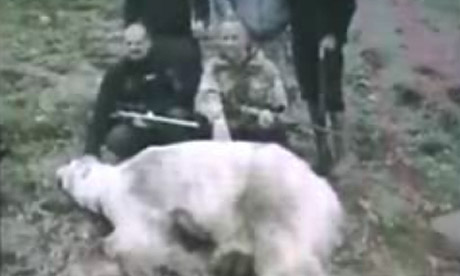
The polar lies dead after being shot by police in Iceland

A polar bear that swam more than 200 miles in near-freezing waters to reach Iceland was shot on arrival in case it posed a threat to humans.
The bear, thought to be the first to reach the country in at least 15 years, was killed after local police claimed it was a danger to humans, triggering an outcry from animal lovers. Police claimed it was not possible to sedate the bear.
The operation to kill the animal was captured on film.
The adult male, weighing 250kg, was presumed to have swum some 200 miles from Greenland, or from a distant chunk of Arctic ice, to Skagafjordur in northern Iceland.
"There was fog up in the hills and we took the decision to kill the bear before it could disappear into the fog," said the police spokesman Petur Bjornsson.
Iceland's environment minister, Thorunn Sveinbjarnardottir, gave the green light for police to shoot the bear because the correct tranquiliser would have taken 24 hours to be flown in, the Icelandic news channel Visir.is reported.
Sveinbjarnardottir's account was disputed by the chief vet in the town of Blönduó, Egill Steingrímsson, who said he had the drugs necessary to immobilise the bear in the boot of his car. "If the narcotics gun would have been sent by plane, it would have arrived within an hour," he said. "They could keep tabs on the bear for that long."
Steingrímsson also criticised police for not closing a mountain road where people congregated after hearing news of the bear. "There were around 50 to 60 people there watching. The police did not have many options when the bear ran down the hill, approaching the crowd," Steingrimsson said. "I'm very unsatisfied that the police did not try to catch it alive and did not close the road."
The oldest record of polar bears being sighted in Iceland is from 890, 16 years after the first settlers arrived. The last visit was in 1993, when sailors saw a bear swimming off the coast of Strandir. It was also killed.
Polar bears were frequently tamed during the middle ages, but since then no bear has been captured alive in Iceland. Receding North Pole ice is diminishing their hunting and mating grounds and jeopardising their survival.
A spokesman for PolarWorld, a German group dedicated to the preservation of the polar regions and the creatures which inhabit it, called the bear's death "an avoidable tragedy ... another great day for mankind".


 http://website.lineone.net/~polar.publishing/curseofthedriftice.htm

Curse of the Drift Ice

by Thor Edward Jakobsson, translated by Keneva Kunz

Dr Thor Jakobsson is the head of the Sea Ice Research Unit of the Icelandic Meteorological Office and a member of the Expert Team on Sea Ice at the World Meteorological Organisation. His article looks at the chief characteristics of sea ice in Icelandic waters and its impact on the country and its people. Translated by Keneva Kunz.


The habitat of the polar bear extends across the polar ice. The animal ranges widely, travelling great distances across the frozen ocean surface. It catches fish and seals by diving skilfully off the edge of the ice in pursuit of its prey. It can also swim great distances, across long stretches of open water or from one ice flow to another. A polar bear has no easy life, but it is a hardy animal, which can withstand all sorts of trials.
Viewing a polar bear in its natural environment is an engaging experience. The author was once aboard an icebreaker in midwinter, located in Baffin Bay between Greenland and Canada. Endless, gleaming white stretches of ice surrounded us on all sides. We were stuck fast, aboard Canada's largest icebreaker, so thick and solidly frozen was the ice.
One day we saw a grey spot on the horizon to the south, which appeared to be moving. Through binoculars we could see that it was a polar bear travelling across the ice in the direction of the vessel. As it approached we could see two cubs trotting along beside their mother. The she-bear forged ahead and passed the icebreaker at what she must have considered a reasonable distance. The cubs were curious and sniffed in the direction of the icebreaker. But their mother had no time for foolishness and the little family gradually disappeared from our sight on its journey north across the expanse of ice.
Icelandic annals contain fairly frequent reports of polar bears which had been transported to Iceland by polar ice. As might be expected, they were more frequent visitors in past centuries when the ice was more extensive. All the same, they were a rare enough sight to cause a flurry of excitement when word spread of a polar bear in the vicinity. People closed themselves securely in their dwellings while the most daring men joined up to take on the uninvited guest.
There are stories, for example, of the shooting of a polar bear in 1792 in the West Fjords and another in North Iceland. In 1802 two bears came ashore in the Strandir district of the West Fjords. After spending several days visiting fish-storage shacks, one of the bears was killed. Nothing more was heard of the other. In 1874, a number of polar bears came to Iceland; three were killed in the Hornstrandir region of the West Fjords while three came ashore in Mjóifjörður in the East Fjords. Bears have not been known in Iceland since the year 1988, although in 1993 fishermen noticed a polar bear swimming several miles offshore.
In recent years polar bears have been a rarity, since the polar ice has been much less extensive, as was mentioned. Polar bears also decreased in number due to human impact, but since they have become protected their numbers have grown once more. Some scientists are concerned that the shrinking polar ice cap resulting from the Greenhouse Effect will make it more difficult for the polar bear to survive.